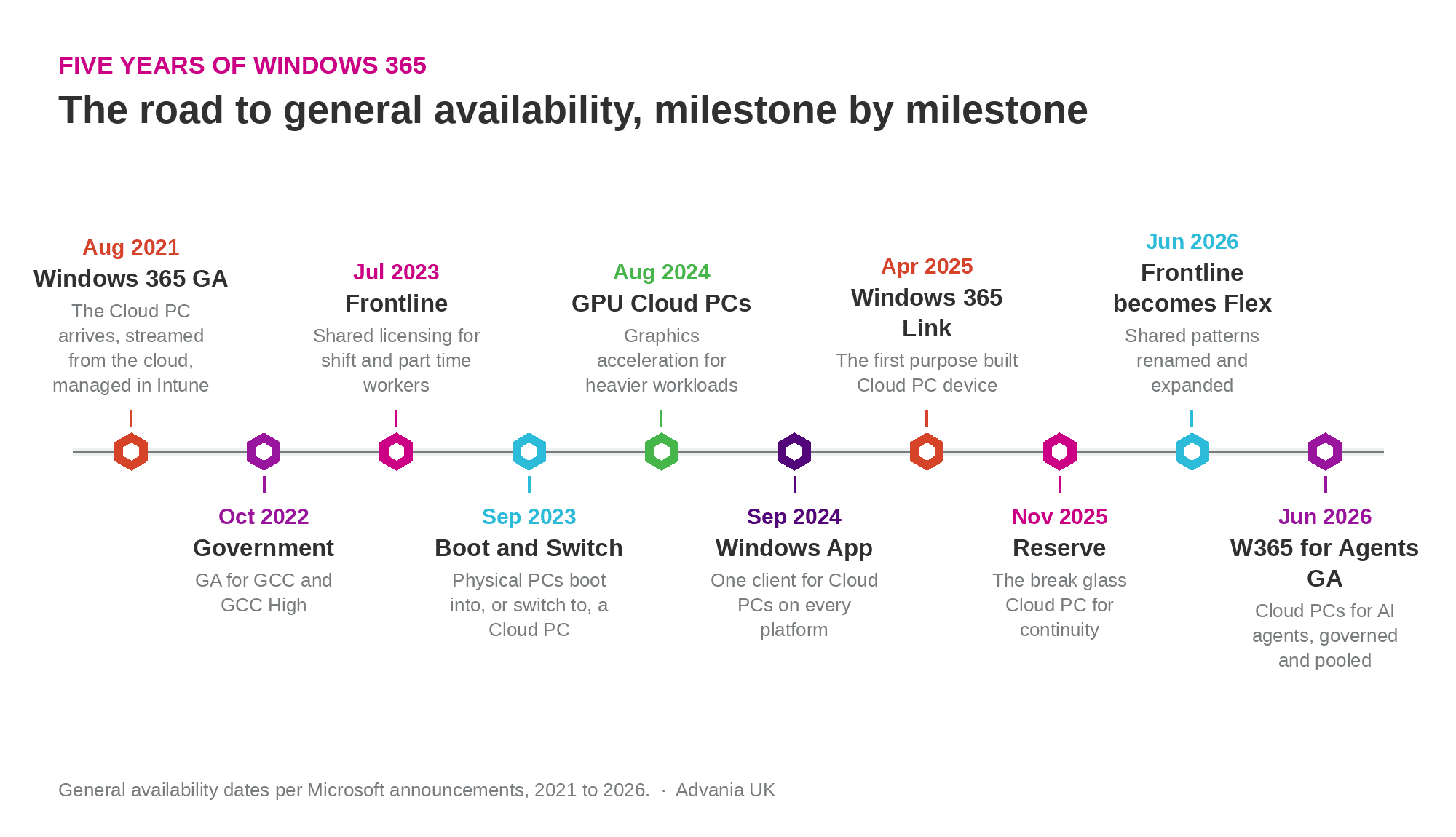





Five years ago this week, Windows 365 went live. I have spent most of my time since deploying it, automating it, speaking about it, and writing about it, so an anniversary feels like a fair moment to take stock. Where did it come from, what has it become, and where is it going next?
Why Microsoft built it
Cast your mind back to July 2021. Most organisations had spent a year improvising remote work: laptops couriered to spare bedrooms, VPNs creaking, and IT teams discovering that the traditional virtual desktop, powerful as it is, needs specialist skills most teams simply do not have.
Microsoft’s answer was to create a new category. Satya Nadella introduced it like this: “Just like applications were brought to the cloud with SaaS, we are now bringing the operating system to the cloud.” The tagline was hybrid Windows for a hybrid world, and the promise was radical in its simplicity: your Windows desktop, streamed securely from the cloud to any device, bought like a subscription as opposed to built like an engineering project.
The press reached for an easier comparison, and it stuck: the Netflix of the desktop. Your PC, streamed to wherever you are, on whatever screen is in front of you.
At Advania we saw this early, as one of the first partners in the private preview, and the appeal was obvious from the first deployment. No virtualisation architects, no capacity planning, no image gymnastics. A licence, a policy in Microsoft Intune, and a working corporate desktop, in the time it takes to make a coffee. Windows 365 took the hardest infrastructure project in end-user computing and turned it into an administration task.
Where it actually landed
So, five years on, did the Netflix vision come true?
My honest answer: not yet. For Windows 365 to truly be the Netflix of the desktop, it needs to reach homes as naturally as it reaches enterprises. Streaming your personal PC to any screen in your life is still not a mainstream consumer reality. The vision is intact, but the audience so far is a business one.
What has happened instead is quieter and, for those of us who run IT estates, more useful. Windows 365 has grown from one product into a genuinely well-rounded desktop as a service family. Windows 365 Enterprise for the everyday dedicated Cloud PC. Windows 365 Flex for shift workers and shared patterns, where one licence can serve multiple people or machines. Cloud Apps for streaming just the application rather than the whole desktop. Windows 365 Reserve as a break glass Cloud PC for the day a laptop dies. Purpose built hardware in Windows 365 Link, GPU options for heavier workloads and lately, a developer image that arrives ready to code.
Almost every gap that made a customer say “Cloud PC is not quite right for us” in 2021 has since been closed, and the direction of travel is one platform, one management plane. Everything lands in Intune, next to the physical estate, managed by the same team with the same policies. That, more than streaming, is the quiet revolution: the Cloud PC stopped being a separate discipline and became just another device type your endpoint team manages.
That is also why adoption keeps coming from practical, unglamorous places. Mergers and acquisitions, where a new workforce needs a secure desktop before laptops can ship. Contractors and offshore teams on unmanaged devices. Regulated roles where data must never land on local hardware. Business continuity. These are not the scenarios of the launch keynote, but they are where Cloud PCs quietly earn their keep, and they are where we at Advania have deployed them most.
The chapter nobody predicted
Here is the part I would not have guessed five years ago: the newest users of Windows 365 are not people.
Windows 365 for Agents reached general availability this summer. It gives AI agents, the kind built in Copilot Studio that work applications through the screen the way a person does, their own pool of Cloud PCs. An agent checks out a machine, signs in with its own identity, does its work, and checks the machine back in, at which point it resets. Each of those Cloud PCs is Entra joined, Intune enrolled, and governed by Conditional Access, exactly like the laptops your team already manages.
Think about what that means. The infrastructure Microsoft built to stream Windows to humans turned out to be precisely the right shape for something nobody was talking about in 2021: giving software workers a governed place to work. The apps that never got APIs, the legacy systems every organisation quietly depends on, suddenly have an automation story, because an agent can simply use them.
We are deploying Windows 365 for Agents inside Advania right now, using agents to simplify project processes that span multiple systems, and we are learning a great deal from it: about prompt design, about guardrails, and about what it takes to run non-human workers safely alongside human ones. It is genuinely promising. It also needs more time, and more real deployments across more customers, before anyone should make any sweeping claims. That said, what I will say is that the governance question is no longer hypothetical. If agents are coming to your estate, they will arrive as endpoints, and the teams who manage endpoints today should be at the table when they do.
The next five years
The first five years of Windows 365 were about proving the operating system could live in the cloud, and about rounding out a family of services until the answer to “can a Cloud PC do this?” became yes more often than no. The consumer dream is still out there, waiting for the day Windows streams into homes as easily as a film does.
But the next five years, I suspect, will be defined by a different question: not just where Windows runs, but who, and what, signs into it. People on any device. Developers in ready-made environments. Agents in governed pools. One platform underneath all of it, managed in one place.
Not a bad outcome for a product that started as a slightly odd idea called a Cloud PC.
If you are working out where Windows 365 fits in your organisation, whether that is modern desktops, business continuity, or a first safe step with agents, it is a conversation we have every week at Advania, and I am always happy to have it. Get in touch.